Wednesday, June 25, 2025

What We Don’t Want to Admit About Halle Bailey, Baby Mamas, and Modern Feminism

Not Every Man Is Toxic: Rethinking the Modern Baby Daddy vs. Baby Mama Story


By The Dreamer’s Pause

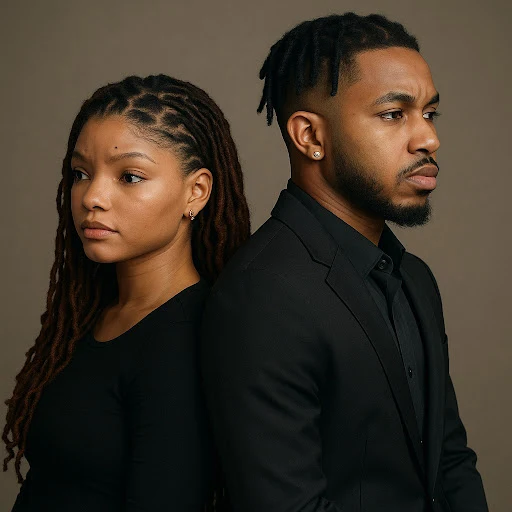
There’s a story I’ve been watching unfold quietly for nearly a year now—one that reflects a bigger issue than just celebrity drama. It’s the ongoing tension between Halle Bailey and DDG, and the way their co-parenting situation has been playing out online.

At first glance, it looks like your usual celebrity breakup. But if you look a little closer—if you apply just a bit of discernment—you start to notice something deeper: a pattern where the baby mama controls the narrative, while the father is pushed aside, judged, and silenced.

This isn’t just about Halle and DDG. It’s about the growing number of men who feel voiceless in modern co-parenting, especially when the court of public opinion is always ready to declare them guilty—before hearing their side.


📌 We’re So Quick to Side with the Baby Mama

Let’s be honest: when a relationship ends, especially one involving a child, society almost always defaults to believing the mother.
Why? Because women are often seen as natural nurturers, while men are expected to “deal with it” quietly, no matter what pain they’re going through.

And in the age of social media, this bias gets louder.

In Halle’s case, she’s publicly praised as a graceful new mom. She shares soft, glowing images with baby Halo, shows strength, and keeps her image tight. Meanwhile, DDG has spoken—sometimes emotionally—about being kept from his child, about being painted as someone he isn’t.

Yet every time he speaks, the response is the same:

> “He’s bitter.”
“He’s a clout-chaser.”
“He’s the problem.”


But what if he’s not? What if we’ve been ignoring another side—just because it makes us uncomfortable?


🎭 Image Isn’t Character


Let me say this carefully: someone’s public image is not the same as their private behavior.

Many of us have learned this the hard way—either through friends, relationships, or just observing public figures. Social media only shows what people want us to see.

So when a woman presents as “calm,” “spiritual,” or “mature,” we assume she must also be fair.
But how fair is it when one parent can post their child freely online, while the other gets legally restricted from doing the same?
How fair is it when we support one side simply because her platform is polished and palatable?

This double standard is real—and it’s growing.


⚠️ The Modern Baby Daddy vs. Baby Mama Dilemma

Let’s be real: modern co-parenting comes with challenges.
But the public often doesn’t recognize how much power a mother can hold—not just in courtrooms, but in social media narratives.

So many famous men have found themselves in this same spot:

Keke Palmer’s ex, Darius, painted as controlling.

Summer Walker’s ex, London, dismissed completely.

G Herbo, Zayn Malik, Rob Kardashian—all facing similar silencing.


In each case, we see a pattern of men speaking up—but their words are drowned out by the noise of support aimed at the mother. And yes, many of these men have made mistakes too. But should that mean they no longer deserve a voice, or a bond with their child?


🧠 Discernment > Blind Loyalty

This blog isn’t about attacking women. It’s about asking for fairness.
We need to stop supporting people just because they look like us or speak like us.
Just because someone is a woman doesn't mean they are always right.
Just because someone is soft-spoken doesn't mean they aren’t controlling behind the scenes.

Discernment means looking at the full picture—not just the filtered one.

When a man says he’s not allowed to see his child, that should alarm us.
When a father expresses emotional pain, we should pause before laughing or ignoring him.
Because when we silence men in this way, we not only rob children of their fathers—we rob truth of its balance.


🧱 Building Better Conversations

I’m not here to say that Halle Bailey is the worst mother.
I’m saying she might not be the image people blindly celebrate.
And if she’s using her influence to manage a one-sided version of her co-parenting story, that matters.

We need platforms where men can speak without being ridiculed.
We need space for both parents to be human, flawed, growing—and held accountable equally.

Because not every man is toxic.
And not every woman is innocent.

Disclaimer: Images used on this blog are for illustrative purposes only and remain the property of their respective owners. No copyright infringement is intended.

© 2025 The Dreamer’s Pause. All rights reserved.


Tuesday, June 24, 2025

The K-Word Is Not Just a Lyric: BabyDaiz Crossed the Line

🎤 A Word I Never Knew — And Why It Should Never Be Said Again: Baby Diaz 


This week, I came across a video on TikTok that truly left me stunned. A South African-born rapper named BabyDaiz, who is Congolese like me, used a word in one of his songs — a word I had never heard before in my life. A word that shook me. A word that, even now, I will not repeat. Let’s just call it “the K-word.”

I want to share what I’ve learned, how I feel, and why I believe this moment matters — especially for young people like me, born in South Africa, carrying Congolese roots, and navigating between cultures, languages, and identities.


⚠️ The K-word: A Word of Hate

What is the K-word? Historically, it is one of the most offensive racial slurs ever used in South Africa. It was weaponized during colonialism and apartheid, used to degrade, dehumanize, and humiliate Black South Africans — in workplaces, schools, courts, and homes.

Today, it is considered hate speech under South African law. Just saying it out loud — in a song, online, or in conversation — can result in legal consequences, social backlash, or even criminal charges.

It’s not just “a bad word.” It’s a deep wound, tied to centuries of oppression, racism, and suffering. And using it casually — especially in music — is not art. It’s not edgy. It’s not funny. It’s dangerous.


🌍 But Here's the Shocking Part…

I found out that this word didn’t even start in South Africa.

Its roots go far back — to Arabic. The word "kāfir" (كافر) simply means non-believer or disbeliever in Islamic theology. It appears in the Qur'an and is still used by Muslims around the world to describe those who reject the faith.

But during colonial times, Europeans took that word and twisted it — using it to label Africans who didn’t share their religion, their race, or their worldview. Portuguese colonists spread it into Africa, and eventually, it became a slur in the mouths of slave traders, settlers, and racists. In South Africa, it evolved into a weapon of white supremacy.

It’s wild to me that one word could travel through so many languages and lands — only to become something so cruel and shameful.


🎧 BabyDaiz and the Problem of the Song


The song where I first heard this word is called “Alex Tobina” by BabyDaiz. He’s a young artist born in Cape Town, but clearly connected to Congolese culture — the lyrics are mostly in Lingala, and the Congolese flag even appears in his visuals.

So in a way, he's like me: South African-born, but rooted in Congo.

But that doesn’t make it okay.

If anything, it makes it worse — because growing up in this country, we know what that word means. We know how painful it is for Black South Africans. It doesn’t matter if the rest of the lyrics are in Lingala. It doesn’t matter if it was said jokingly, carelessly, or “creatively.” That word hurts, no matter the language, the beat, or the rhythm.


🧠 My First Time Hearing It

This was literally my first time hearing the K-word. I didn’t grow up with it. It’s not part of Congolese history or culture. But after just one TikTok video, I felt a weight on my chest. I couldn’t ignore it.

I started researching, asking questions, reading up on why this word is so powerful — and now I know. And I will never forget.


✍🏾 To Fellow Creatives and Immigrants


To my fellow Congolese youth in South Africa — and to any artist trying to build a brand: we are part of this country. Our words have power here. We share the air, the struggle, and the responsibility.

You don’t get a “free pass” because your parents are from somewhere else. If you’re born here, raised here, benefiting from South African audiences and platforms — then you have to respect this land’s history and trauma.

Let’s not be careless with language. Let’s not entertain people by reopening wounds.

Disclaimer: Images used on this blog are for illustrative purposes only and remain the property of their respective owners. No copyright infringement is intended.


The Deadly Price of Perfection: Elena Jessica’s BBL Story You Can’t Ignore

WHEN BEAUTY GOES WRONG: THE SAD, SAD BBL STORY YOU NEED TO HEAR Hey Dreamers 👋🏿, listen. I need you to hear this because this ...

Popular Posts